
A 25 cubic foot refrigerator sits in that sweet spot between compact and roomy, large enough to feed a family without dominating your kitchen layout. Whether you’re upgrading an aging fridge or planning a kitchen remodel, picking the right 25 cu ft model comes down to understanding what you actually need versus what marketing departments want you to buy. This guide walks through the specifications, features, and practical installation details that separate a solid choice from buyer’s remorse. By the time you finish reading, you’ll know exactly what to look for and how to make sure the model you pick works for your space and budget.
Table of Contents
ToggleKey Takeaways
- A 25 cu ft refrigerator offers the ideal balance for families of four, providing enough storage for weekly groceries and meal prep without wasting energy or kitchen space like oversized models.
- ENERGY STAR certified 25 cu ft models save $1,500–$2,000 in electricity costs over 15 years compared to non-certified versions, making the upfront premium of $200–$400 a smart financial investment.
- French door layouts offer the widest shelves for full-size baking sheets and best organization, while side-by-side models work in tight kitchens, and top freezer designs provide the lowest upfront cost for households that don’t freeze bulk items.
- Before purchasing, verify your kitchen doorways, stairwells, and opening can accommodate a 25 cu ft refrigerator (typically 32–36 inches wide and 65–70 inches tall), and ensure 1–3 inches of clearance around the unit for proper airflow.
- Ice and water dispensers add $300–$600 to the price and increase energy use by 5–10%, so evaluate whether you’ll actually use them versus a standard 25 cu ft model without built-in features.
- Set your refrigerator to 37–40°F and freezer to 0°F after allowing 4–6 hours for refrigerant to settle post-delivery, and avoid plugging in immediately to prevent compressor damage.
Why A 25 Cubic Foot Refrigerator Might Be Your Best Choice
A 25 cu ft refrigerator is the Goldilocks appliance for many households. At that capacity, you get enough room to store a week’s groceries, accommodate meal prep containers, and still have breathing room for leftover casseroles without playing Tetris every time you open the door. Standard full-size fridges typically range from 20 to 28 cubic feet, so 25 cu ft puts you right in the middle of that practical zone.
For a family of four, this size works well. You won’t constantly run out of space, but it’s not so oversized that you end up with forgotten containers of mystery food in the back corners. If you entertain regularly, the extra capacity is handy for pre-game storage without needing a second fridge in the garage. Smaller single-door or compact models (under 20 cu ft) leave many families frustrated within a year: larger models (over 28 cu ft) consume more energy and take up floor space that many kitchens simply can’t spare.
Key Features And Specifications To Compare
When shopping for a 25 cu ft refrigerator, the cubic footage is just the starting point. Energy rating, type of compressor, and ice/water dispensing options add cost and complexity. Look for an ENERGY STAR certification, these models typically use 10-15% less energy than non-certified versions, which translates to $50-75 in annual savings over the life of the appliance.
Temperature control matters too. Models with dual independent thermostats let you adjust the fridge and freezer separately, which is genuinely useful if you store delicate berries or need a deeper freeze for longer-term storage. Shelving material, whether glass, plastic, or adjustable metal, affects what you can store and how easy cleaning is. Plastic is lighter and cheaper: glass is sturdier and easier to wipe down.
Built-in water and ice dispensers add $300-600 to the price but eliminate the need for a separate water pitcher or ice cube trays. They do require a water line connection and periodic filter changes. If you’ve got space constraints or want to keep installation simple, a standard refrigerator without dispensers is a valid choice.
Compressor type also varies. Inverter compressors (common in modern fridges) cycle on and off as needed, using less energy than fixed-speed models that run at full power constantly. It’s a quieter, more efficient approach, and worth the extra cost over 10-15 years of ownership.
Layout Options: Side-By-Side, French Door, And Top Freezer
Three main layouts dominate the 25 cu ft category, and each has tradeoffs worth understanding.
Side-by-side fridges divide the space vertically, freezer on one side, fridge on the other. Pros: easy access at eye level, narrow door swing (useful in tight kitchens), and good visibility of everything. Cons: narrow shelves mean you’ll struggle with large platters or sheet pans, and the freezer side is often colder at the door edges. These are popular but create real frustration if you cook a lot.
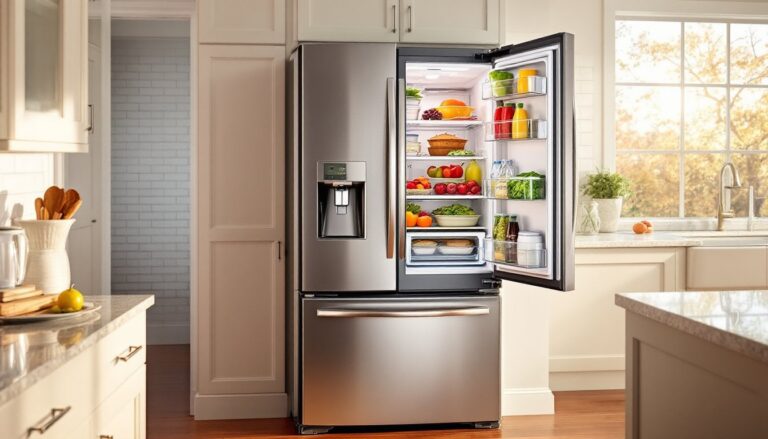
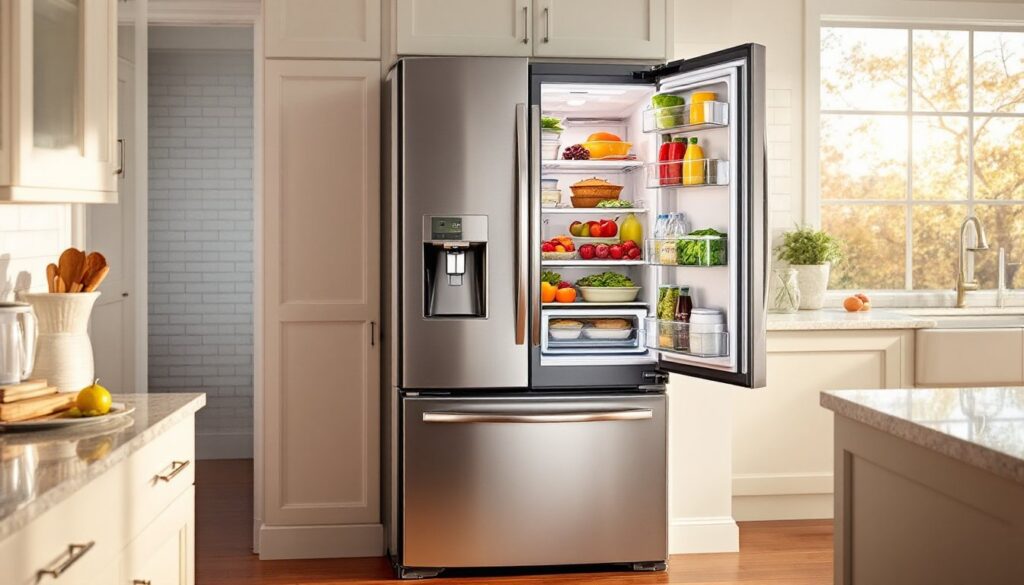
French door models stack the freezer below and have two doors that swing open to the fridge section above. This layout has exploded in popularity over the last decade. Pros: wide shelves that accept full-size baking sheets, excellent fridge organization, and a modern look. Cons: bending to reach frozen items daily gets old, and the lower freezer can trap cold spots. Cost runs $100-200 higher than side-by-side for the same capacity.
Top freezer refrigerators put the freezer above, the most traditional layout. Pros: lowest cost, simplest mechanics, and the freezer is at waist level (no bending). Cons: they look dated, and the small freezer compartment fills up fast in families with kids. If you rarely freeze full meals or bulk items, this option saves money upfront but provides less flexibility.
The best choice depends on your actual usage. A family that batch-cooks benefits from French door width and bigger freezer space. Someone in a narrow kitchen with elderly residents in the home might prefer side-by-side for accessibility. Be honest about your routine, not what the showroom model looks like.
Energy Efficiency And Cost Considerations
Energy costs are the invisible bill that many homeowners ignore until they realize their fridge is running 24/7 for a decade. A non-certified 25 cu ft refrigerator might use 500-700 kWh annually, depending on compressor type and insulation quality. At current U.S. average electricity rates (roughly $0.14-0.16 per kWh), that’s $70-112 per year just to keep food cold.
An ENERGY STAR certified model at the same capacity uses 400-500 kWh annually, a real difference. Over 15 years (the typical lifespan), that’s roughly $1,500-2,000 in saved electricity. The upfront cost difference between a certified and non-certified 25 cu ft fridge is typically $200-400, so the payback is solid math, not greenwashing.
Other cost factors: ice/water dispensers add 5-10% to annual energy use (the compressor runs more often to refreeze water). French door models sometimes run slightly warmer at the door edges due to design: if you’re sensitive to food spoilage, test the real-world temperature hold before buying. Stainless steel exteriors look great but show fingerprints constantly and cost 10-15% more than painted finishes. Budget accordingly.
Compare the yellow EnergyGuide label on every model you’re serious about. The label shows estimated annual operating cost, which is more useful than raw wattage. Some retailers, including studies from Good Housekeeping’s refrigerator testing, break down real-world energy performance alongside capacity and features, worth a look before checkout.
Installation And Space Planning Tips
Before you buy, measure your space properly. A 25 cu ft fridge is roughly 32-36 inches wide, 65-70 inches tall, and 30-34 inches deep (including the door when fully open). Check your doorways, stairwells, and kitchen opening to confirm the model actually fits through. A delivery team can squeeze most refrigerators in, but not always without risk to trim or walls.
Clearance around the fridge matters. Most models need at least 1 inch on each side and 2-3 inches at the back for airflow. Cramming a fridge into a too-tight space means the compressor works harder, energy costs climb, and failure comes early. If your kitchen has tight cabinetry, measure twice and confirm the spec sheet guarantees the clearance you’ve got available.
If your model has an ice/water dispenser, you’ll need a water line connection. If your kitchen has no existing water line near the fridge location, a plumber can run one (typically $150-400 depending on distance and existing rough-in). This isn’t a DIY task unless you’ve done water line work before and your local code allows it. Most jurisdictions require licensed work.
Electrical outlet placement is simpler but easy to overlook. The outlet should be within 6 feet of the fridge location (standard cord length) and preferably not on the same circuit as other high-draw appliances like a microwave or dishwasher. A dedicated 15-amp circuit for the fridge prevents nuisance breaker trips.
After delivery, let the fridge sit for 4-6 hours before plugging it in. This allows refrigerant to settle if the unit was transported on its side or at an angle. Plugging in too soon risks compressor damage. Set the temperature to 37-40°F for the fridge and 0°F for the freezer once it’s running, these are standard safe temps. You can adjust based on how your actual food behaves over a week or two.
Conclusion
Choosing a 25 cu ft refrigerator means balancing capacity, layout preference, energy efficiency, and real-world kitchen constraints. There’s no single “best” model, it’s about matching the refrigerator to your household’s actual cooking and storage patterns. Measure your space, compare EnergyGuide labels, think through whether you actually use ice dispensers, and be honest about how you cook. A solid 25 cu ft fridge should serve a family well for 12-15 years, so spending time on the choice now pays dividends later.